
The Question Nobody in Luxury Is Asking
There is a question very few people in the world of luxury have asked out loud: who owns Rolex?
The answer is not a family office. It’s not a private equity fund. It’s not a conglomerate like LVMH or Richemont. It’s not an heir, nor a group of investors. The answer is a Swiss charitable foundation that carries the name of a man who died in 1960 — and who, before his death, made one of the most extraordinary business decisions of the 20th century: he gave his entire company to no one.
And in the language of luxury and high-level business, that changes everything.
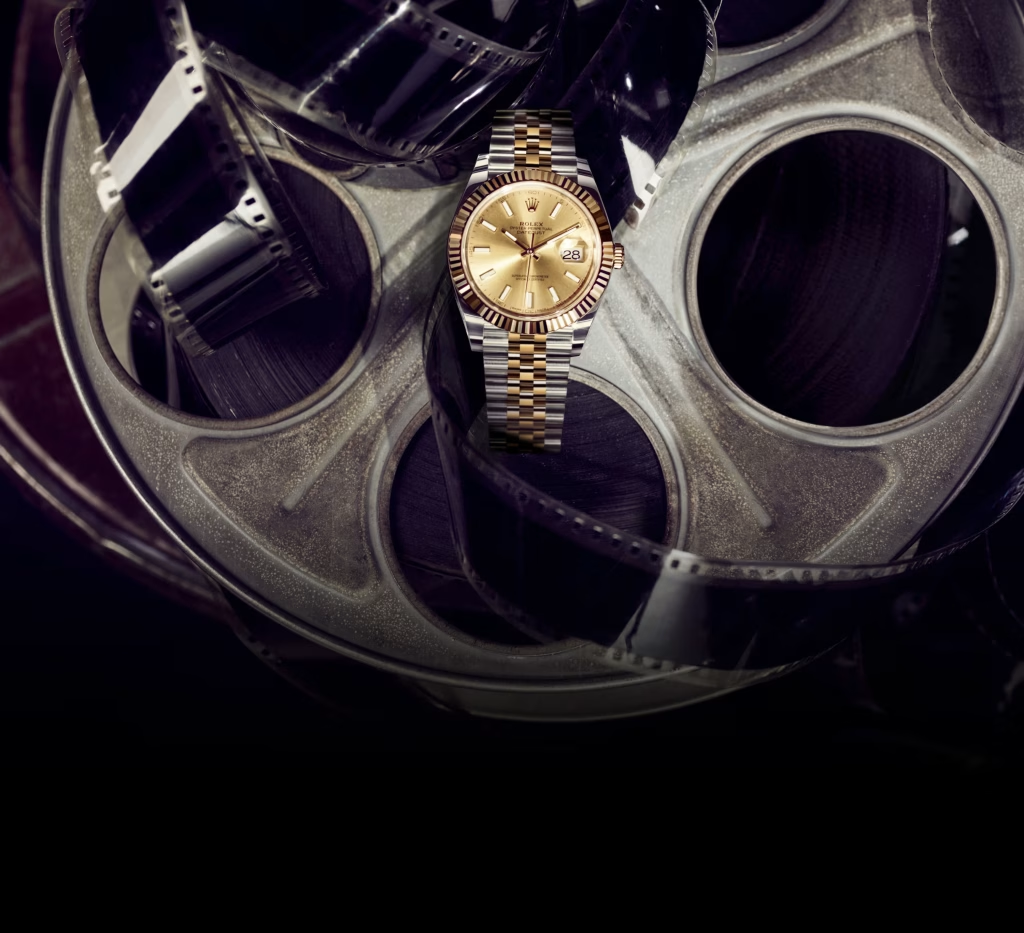
The Context: Who Was Hans Wilsdorf and What He Built
The story of Rolex begins in London, in 1905, when a 24-year-old German entrepreneur named Hans Wilsdorf founded a company with a conviction that, at the time, sounded almost absurd: that the wristwatch, then considered imprecise, decorative, and largely feminine, could become the most reliable precision instrument in the world.
At 24, Wilsdorf founded a company in London specializing in the distribution of timepieces. He envisioned a watch worn on the wrist — at a time when wristwatches lacked accuracy and were primarily seen as jewelry for women.
The name Rolex does not come from a rational process. Wilsdorf experimented with countless combinations of letters, arriving at nearly a hundred possible names — none of which felt right. One morning, while riding on the upper deck of a bus along Cheapside in London, something whispered “Rolex” into his ear. Five letters. Easy to pronounce in any language. Legible on any dial.
What followed was a series of innovations that would redefine watchmaking. In 1926, Rolex introduced the Oyster, the first waterproof wristwatch. In 1931, it patented the Perpetual self-winding mechanism. These two inventions (waterproofness and autonomy) form the technical foundation of everything Rolex represents today.
But Wilsdorf’s most profound innovation was not technical. It was structural. And it came in 1945.

The Decision: The Foundation as an Act of Legacy
In 1944, Hans Wilsdorf’s wife, Florence, passed away. Wilsdorf, who had no children, was confronted with a question few founders truly face in their lifetime: what happens to all of this when I’m gone?
His answer was to create, on August 1, 1945, the Hans Wilsdorf Foundation, a private Swiss foundation based in Carouge, in the Canton of Geneva. The foundation was established following his wife’s death, and, as confirmed in his will, Wilsdorf transferred all his shares to it to ensure that Montres Rolex SA would outlive him.
When Wilsdorf died in 1960, the transfer was completed in accordance with his wishes. One man built one of the most powerful luxury brands in history, and instead of selling it, listing it, or passing it down to a family dynasty, he gave it entirely to a charitable structure. No heirs. No shareholders demanding quarterly returns. No board of investors pushing for cost-cutting or brand extensions.
The structure he created is, from a legal standpoint, as simple as it is extraordinary: the Hans Wilsdorf Foundation is a private Swiss foundation. It is the sole owner of the Rolex group. One hundred percent. No exceptions.
How It Works: The Model No Business School Teaches
To understand why this matters, you first need to understand how the conventional luxury business model works.
Most of the world’s major luxury brands belong to publicly traded conglomerates. LVMH — home to Louis Vuitton, Dior, Bulgari, TAG Heuer, and more than seventy brands — is listed on the Paris Stock Exchange. Richemont, owner of Cartier, IWC, Jaeger-LeCoultre, and Vacheron Constantin, is listed in Zurich. Kering, which owns Gucci and Saint Laurent, is also public. This means their decisions are structurally influenced by financial markets, quarterly reporting cycles, and the expectations of thousands of shareholders.
Rolex has none of those bosses.
Within this unique structure, the company is not publicly listed, has no public shareholders, and does not disclose detailed financial information. It operates under a single strategic direction: its own perpetuation.
This creates a level of operational freedom that is, in today’s corporate landscape, almost unheard of. The foundation’s core objectives are to reinforce Rolex’s independence, safeguard the purity of the brand, and reinvest profits back into the company. There are no quarterly earnings calls. No analysts to answer to. No pressure to launch a fragrance line or collaborate with a streetwear brand to capture new demographics.
Rolex’s profits flow in two directions: back into the company, and into the foundation. The Hans Wilsdorf Foundation operates in the public interest, supporting initiatives across culture, education, social action, humanitarian aid, and environmental protection.
The scale of this philanthropy is difficult to quantify precisely as Rolex does not publish its financials. However, statements attributed to its Secretary General, Marc Maugué, have suggested that the foundation allocates approximately 300 million Swiss francs annually to charitable causes, with the capacity to increase that figure for larger projects.
To put that into perspective: this positions the Hans Wilsdorf Foundation as a major philanthropic actor in Switzerland, funded entirely by the people who buy the watches.
The Analysis: Why This Model Produces What It Produces
1. Permanence as Competitive Advantage
A company that is not publicly traded, that does not answer to capital markets, and that operates with a single mandate — to endure with excellence — makes decisions on a time horizon that no public company can afford. Since Rolex has no external shareholders, it is not required to deliver short-term financial returns to a public investor base. There are no quarterly earnings calls. No activist investors demanding cost cuts.
This translates into something very tangible: Rolex can invest in R&D, manufacturing, and training for decades before seeing returns. It can ignore trends without immediate financial consequences. It can say no to almost anything.
2. Vertical Integration as Philosophy, Not Tactic
Rolex designs, develops, and manufactures most of its components in-house, following a vertically integrated production model — from foundry to final assembly. This is not an efficiency decision. It is a statement of principle. Controlling every millimeter of the process is what allows them to guarantee every millimeter of the product.
In luxury, very few brands can claim this. And those that can almost always operate under ownership structures that allow them to prioritize control over margins.

3. Secrecy as Positioning
No one knows Rolex’s exact annual revenue, profit margins, or production volumes. None of it is public. This opacity is not a flaw,it is part of the product
In a world where corporate transparency is the norm and financial data is accessible in real time, Rolex shares nothing. And paradoxically, that amplifies its aura.
Mystery is a form of luxury. The absence of information is, in itself, a statement of position.
4. Purpose as a Long-Term Shield
There is something else the foundation model gives Rolex that does not appear on any balance sheet: long-term moral legitimacy.
When a luxury company can say that its profits support social, cultural, and educational initiatives in Geneva, not as a campaign, but as a structural consequence, its narrative gains a dimension no communications strategy can manufacture.
A real estate agent in China, trying to impress a client with a new watch, is unlikely to realize that the purchase may indirectly support social programs in Geneva. That, too, is part of the brand’s quiet and powerful effect.

A Wealthy Note: Legacy in Perspective
Rolex is not the only company owned by a foundation. There are other notable examples — Bosch in Germany, IKEA in the Netherlands, Novo Nordisk in Denmark. But none combine global recognition, informational opacity, and sustained excellence over more than a century quite like Rolex.
What Hans Wilsdorf built in 1945 was not just a clever legal structure. It was a philosophical bet: that a company can survive, thrive, and remain true to its values if it is freed from the pressure of speculative capital and instead anchored in purpose.
In the language of The Wealth, that has a name: legacy.
Not legacy as a surname or inheritance. Legacy as a system designed to outlive its creator and to continue generating value, in the broadest sense of the word, long after he is gone.
That is Rolex’s crown.
And it has no owner because it never needed one.
Discover more about Rolex: https://www.rolex.com/es-mx/about-rolex/history/1905-1919
Discover more about The Circle: https://thewealthdigital.com/en/the-circle/



Leave a Reply